A financial market is essentially a market where financial instruments are exchanged or traded. Unlike markets dealing with physical goods or services, a financial market involves the creation or transfer of financial assets. Financial assets or instruments represent a claim to the payment of a sum of money at a future point, and/or periodic payments like interest or dividends.
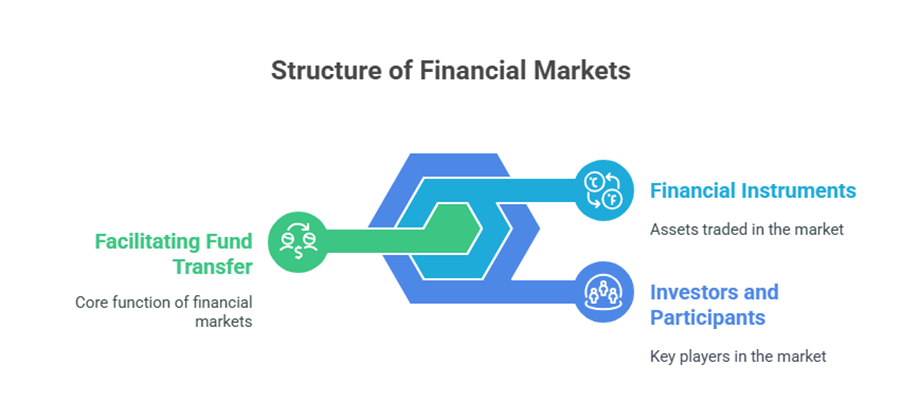
The primary function of financial markets is to facilitate the transfer of funds from sectors with a surplus of funds (lenders) to those with a deficit (borrowers). Typically, households have savings which they lend to corporate and public sectors that require funds exceeding their savings. Financial markets help in providing money and capital supply to industrial concerns and also promote saving and investment habits among the public.
A financial market is not necessarily a physical location but rather consists of investors or buyers, sellers, dealers, and brokers.
Classification of Financial Markets
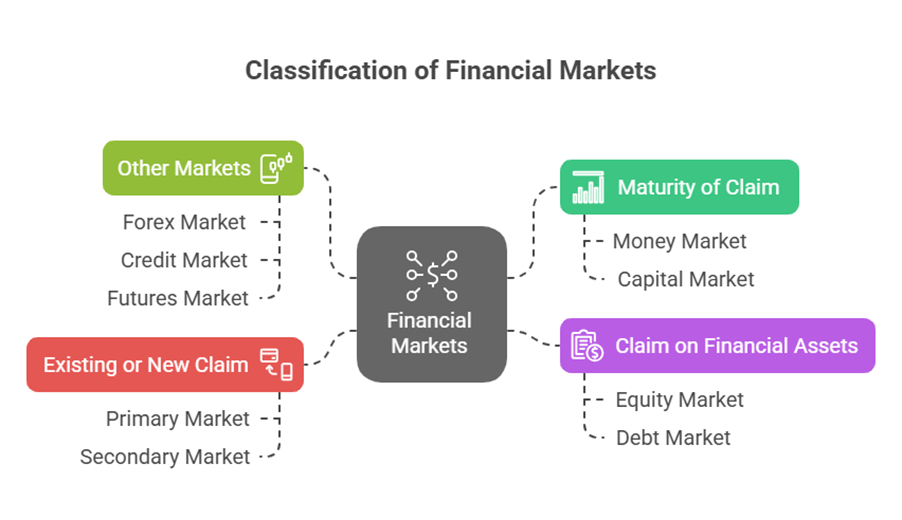
Financial markets can be classified in various ways:
- On the basis of maturity of the claim.
- On the basis of the existing claim or new claim.
- On the basis of domicile.
- On the basis of the claim on financial assets.
- According to the financial instruments they are trading.
- Based on features of services they provide, trading procedures, key market participants, and their origin.
- As organised and unorganised markets.
- As official and parallel markets.
- As foreign and domestic markets.
Based on the maturity of the claim, financial markets are primarily categorized into two types:
- Money Market: A financial market for short-term financial assets.
- Capital Market: A financial market for long-term financial assets.
Based on the claim on financial assets, financial markets are categorized into two types:
- Equity Market: Where equity instruments are traded. Also referred to as the stock market.
- Debt Market: Where debt securities are traded. Also called the fixed income market.
Based on whether the claim is existing or new, financial markets are classified into:
- Primary Market: A market for new issues, where funds are mobilized from investors to corporate capital structures by issuing new securities like IPOs and FPOs.
- Secondary Market: A market where securities that have been issued before are traded. Also known as the aftermarket or stock market, its main objective is to facilitate the transfer of securities and provide liquidity.
Other markets mentioned include:
- Forex Market (Foreign Exchange Market): Deals with multi-currency requirements and the exchange of currencies. It is the largest financial market worldwide. Participants include investment management firms, who use it to facilitate transactions in foreign securities and manage currency exposures. SWIFT (Society for Worldwide Interbank Financial Telecommunication) is a messaging system used by foreign exchange dealers/traders to communicate transactions.
- Credit Market: A market where banks, Financial Institutions (FIs), and Non-Banking Finance Companies (NBFCs) provide short, medium, and long-term loans to corporations and individuals.
- Futures Market: A market dealing in futures contracts, which are agreements to buy or sell something at a designated future date at a predetermined price. Their basic economic function is to provide market participants with an opportunity to hedge against the risk of adverse price movements. Futures can be commodity futures or financial futures, which include stock index futures, interest rate futures, and currency futures.
Money Market
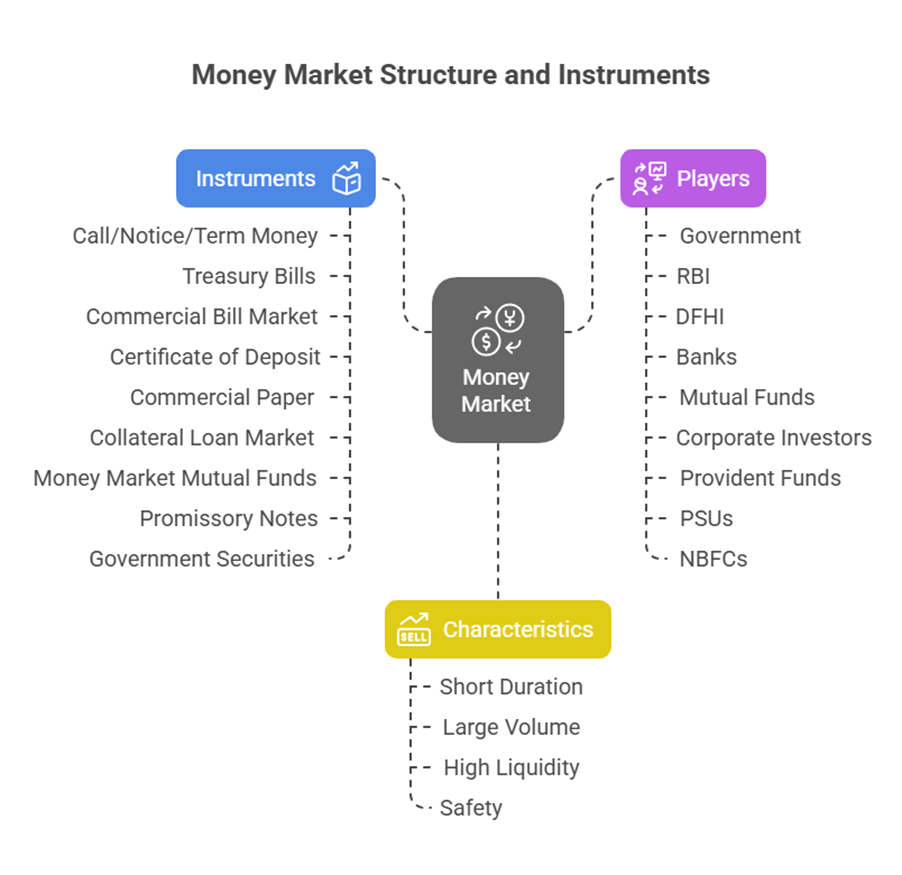
The money market is a wholesale debt market for low-risk, highly-liquid, short-term instruments. It deals in monetary assets of a short-term nature, generally with a maturity period of less than or equal to one year. It is not a physical location but an activity conducted over the telephone.
Key characteristics of money market instruments include short duration, large volume, highly liquidity, and safety due to the issuers’ inherent financial strength. Funds are traded for periods ranging from a single day up to a year. Excess funds are deployed in the money market to meet temporary cash shortages and other obligations.
The important instruments traded in the money market are:
- Call/Notice/Term Money:
- Call money is borrowing and lending by commercial banks for a very short period. It refers to funds transacted on an overnight basis or for 1 day. It is part of the inter-bank money market.
- Notice Money refers to borrowing or lending for a period between 2 days and 14 days.
- Term Money refers to borrowing/lending of funds for a period between 15 days and one year.
- Treasury Bills (T-Bills): Issued by the Central Government to meet its short-term financial commitments. They deal in bills for a short period of not more than 365 days. Treasury bills are discounted securities issued at a discount to face value. Regular T-bills are sold to banks and the public and are freely transferable. They are highly liquid as repayment is guaranteed by the government. Types include 14-day, 91-day, 182-day, and 364-day T-bills based on maturity.
- Commercial Bill Market: Deals in commercial bills issued by firms engaged in business, generally for a period of three months. After acceptance, the bill becomes a legal document and can be transferred by endorsement. The holder can discount the bills with a commercial bank for cash. It is a market for bills of exchange arising from genuine trade transactions, often related to credit sales.
- Certificate of Deposit (CDs): Documents of title to a time deposit issued by commercial banks. They are unsecured, negotiable, short-term instruments in bearer form. The minimum investment is Rs. one lakh and in multiples thereof. Maturity ranges from seven days to not more than one year for banks. CDs are freely transferable by endorsement and delivery. FMPs (Fixed Maturity Plans) often invest in CDs.
- Commercial Paper (CP): Refers to unsecured promissory notes issued by creditworthy companies to borrow short-term funds. They are issued in denominations of 5 lakh or multiples thereof. CPs are transferable by endorsement and delivery. Maturity period lies between 7 days and 365 days. Euro Commercial Papers are short-term money market securities usually issued at a discount for maturities less than one year. FMPs (Fixed Maturity Plans) often invest in CPs.
- Collateral Loan Market: Deals with loans backed by collateral securities. Commercial banks provide short-term loans against government securities, shares, and debentures.
- Money Market Mutual Funds (MMMFs): Schemes that collect small savings and invest them in the money market instruments like T-bills, CPs, CDs, G-Secs. Their main objective is capital preservation, easy liquidity, and moderate income.
- Promissory Notes: A financial instrument traded in the bill market. Also mentioned as a capital market instrument.
- Government Securities: Short-term government securities are traded in the money market.
The major players in the money market include the Government, RBI, Discount and Finance House of India (DFHI), Banks, Mutual Funds, Corporate Investors, Provident Funds, PSUs, and NBFCs. The money market functions as a mechanism of liquidity adjustment. The organized sector of the money market includes instruments traded with a high degree of safety of principal. The unorganized money market is dominated by pawn brokers, chit funds, and nidhis, with less stringent guidelines.
Capital Market
The capital market is a market that specializes in trading long-term and relatively high-risk securities. It is a market for long-term capital, dealing with financial assets with a maturity period of more than one year. The capital market provides long-term debt and equity finance for the government and corporate sector.
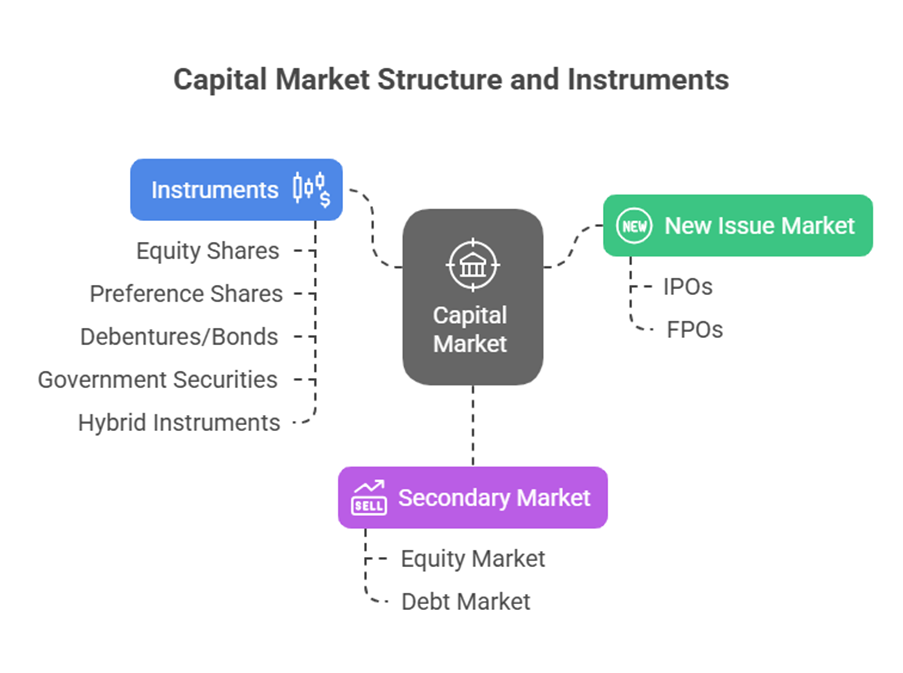
The capital market comprises two segments:
- New Issue Market (Primary Market): This is where new securities are issued for the first time. Funds are mobilized from the surplus sector to the government and corporate sector. Funds are raised through prospectus, rights issues, and private placement. Initial Public Offerings (IPOs) and Follow-up Offerings (FPOs) are examples of new securities issued in the primary market.
- Secondary Market: Also known as the stock market, this is where securities that have been previously issued are traded. Its main function is to provide liquidity to existing securities and facilitate the transfer of ownership. Constituents include equity market, debt market, government securities market, and mutual funds.
The main organized financial markets in India are the money market and capital market. The capital market in India consists of the primary market and the stock exchanges. SEBI (Securities and Exchange Board of India) plays a role in capital market issues and regulation.
Instruments traded in the capital market generally include long-term financial instruments (more than one year period):
- Equity Shares: Represents fractional ownership in a company, where the shareholder undertakes the maximum entrepreneurial risk. A company may issue shares with differential rights. They are traded in the equity market, also called the stock market.
- Preference Shares: Have certain preferential rights, such as the right to receive dividends before equity shareholders. The dividend rate is usually fixed. They are classified into types like cumulative, non-cumulative, participating, non-participating, convertible, and redeemable. Convertible preference shares give holders an option to convert to equity shares.
- Debentures/Bonds: Debt securities where the issuer promises to repay a principal sum plus interest. Debt securities and preferred stock are generally classified as part of the fixed income market. Debentures can be classified based on conditions of issue and redemption, such as naked/unsecured, secured, redeemable, irredeemable/perpetual, registered, bearer, convertible, and non-convertible. Bonds are also normally issued by corporate sectors and government organizations. They can be secured and unsecured, pay-in-kind, redeemable and irredeemable. Deep discount bonds and zero-coupon bonds are also mentioned.
- Government Securities: Long-term government securities are traded in the capital market. This is also called the gilt-edged securities market.
- Hybrid Instruments: Instruments having features of both equity and debenture, such as convertible debentures and warrants. A convertible bond is a debt instrument giving holders the option to convert into equity shares. Warrants entitle the holder to buy underlying stock at a fixed price until expiration.
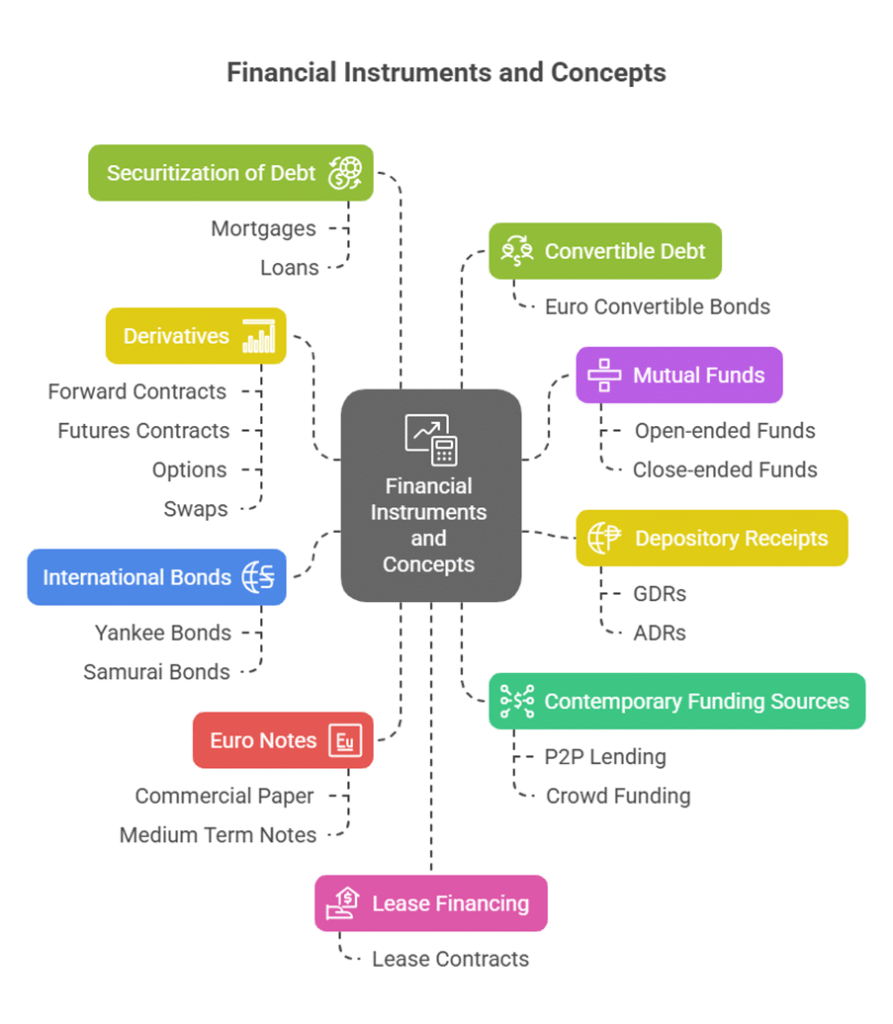
Other Financial Instruments and Concepts
Beyond the traditional money and capital market instruments, sources mention several other financial instruments and related concepts:
- Derivatives: Financial derivatives are instruments whose value is derived from one or more underlying financial assets like securities, indexes, or rates. Basic features include that their value changes in response to changes in the underlying variable and they require little or no initial net investment. They are used for hedging or speculation. Four basic types are forward contracts, futures contracts, options contracts, and swaps.
- Forward Contracts: Agreements to buy or sell an asset at a specified future date at a price agreed upon today. An Indian exporter might use a forward contract to sell foreign currency in the future.
- Futures Contracts: Standardized agreements requiring a party to buy or sell something at a designated future date at a predetermined price. They are highly liquid due to standardization. Most futures contracts are not held to expiration but are squared off by taking an offsetting position. Stock futures call for delivery of shares, but most are settled in cash. Investing in stock futures involves an obligation to square off the position. Financial futures include stock index futures, interest rate futures, and currency futures.
- Options: Represent the right, but not the obligation, to buy (call option) or sell (put option) a security or asset at a specified price (strike price) during a given time. Option pricing and Greeks (statistical values indicating performance trends) are relevant concepts.
- Swaps: Private agreements between two parties to exchange future cash flows according to a prearranged formula. They can be seen as portfolios of forward contracts. Interest rate swaps involve exchanging fixed-rate payments for floating-rate payments.
- Mutual Funds: Investment vehicles that pool funds from multiple investors to invest in securities. They can be classified by structure (open-ended, close-ended) or investment objective (e.g., debt-oriented like money market funds, gold funds, quant funds, cash funds, ETFs, FMPs). Net Asset Value (NAV) is used to value units. Hedge Funds are another type of fund, though their goal is often to maximize return on investment, not just reduce risk like traditional hedging.
- Depository Receipts: Instruments that represent ownership in shares of a foreign company.
- Global Depository Receipts (GDRs): Issued in international markets, representing a bundle of shares of a company.
- American Depository Receipts (ADRs): Specifically traded in the US market, representing shares of a non-US company.
- International Bonds: Bonds issued in domestic capital markets of various countries under different names, such as Yankee Bonds (US), Swiss Francs (Switzerland), Samurai Bonds (Tokyo), and Bulldogs (UK). Eurobonds are mentioned as distinct from Euronotes.
- Euronotes: Short-term unsecured promissory notes, similar to Commercial Paper, issued at a discount for maturities usually less than one year. Medium Term Notes (MTNs) are related fixed interest securities with maturities over one year.
- Convertible Debt: Debt instruments that can be converted into equity shares. Euro Convertible Bonds are quasi-debt securities convertible into depository receipts or local shares.
- Lease Financing: A source of finance involving lease contracts. Types of lease contracts exist.
- Factoring: Refers to the relationship between the seller of goods and a financial firm (the Factor), where the factor purchases receivables.
- Forfeiting: Refers to an exporter relinquishing their right to a future receivable in exchange for immediate cash payment, transferring all risks to the forfeiter.
- Venture Capital: Mentioned as a source of finance.
- Contemporary Sources of Funding: Mentioned as including P2P lending, Equity funding, Crowd funding, Start-up funding. Pitch presentations are used to explain prospects to investors for startup businesses.
- Securitization of Debt: The process of pooling contractual debts (like mortgages or loans) and selling the resulting cash flows to investors as securities.
Functions of Financial Markets
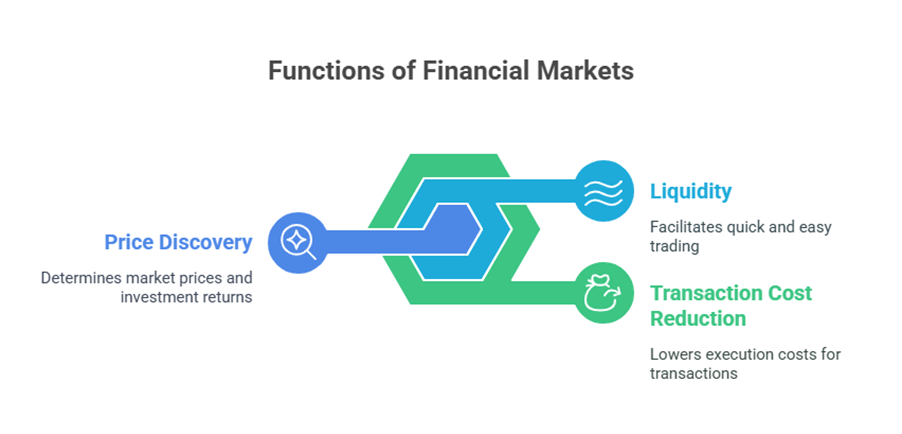
Beyond the primary function of transferring funds, financial markets provide key economic functions:
- Price Discovery: Transactions between buyers and sellers determine the price of traded financial instruments. This process also helps determine the required return from investments, influencing how funds are allocated among those needing them.
- Liquidity: Financial markets provide participants with the ability to buy and sell financial instruments easily and quickly. Money market instruments, in particular, are characterized by high liquidity. The secondary capital market facilitates the transfer of securities and brings liquidity. Liquidity risk is the risk that an asset cannot be traded quickly enough without a loss.
- Reduction of Transaction Costs: Financial markets lower the cost of executing transactions by bringing buyers and sellers together and providing information and standardized instruments.
Financial markets are a key component of the broader financial system of a country, alongside financial institutions and financial services. Financial institutions act as intermediaries, mobilizing savings and facilitating the allocation of funds. They can be banking (creators of credit) or non-banking (purveyors of credit).
Understanding financial markets, instruments, institutions, and related concepts like risk management, sources of finance, investment decisions, and valuation are fundamental aspects of financial management.