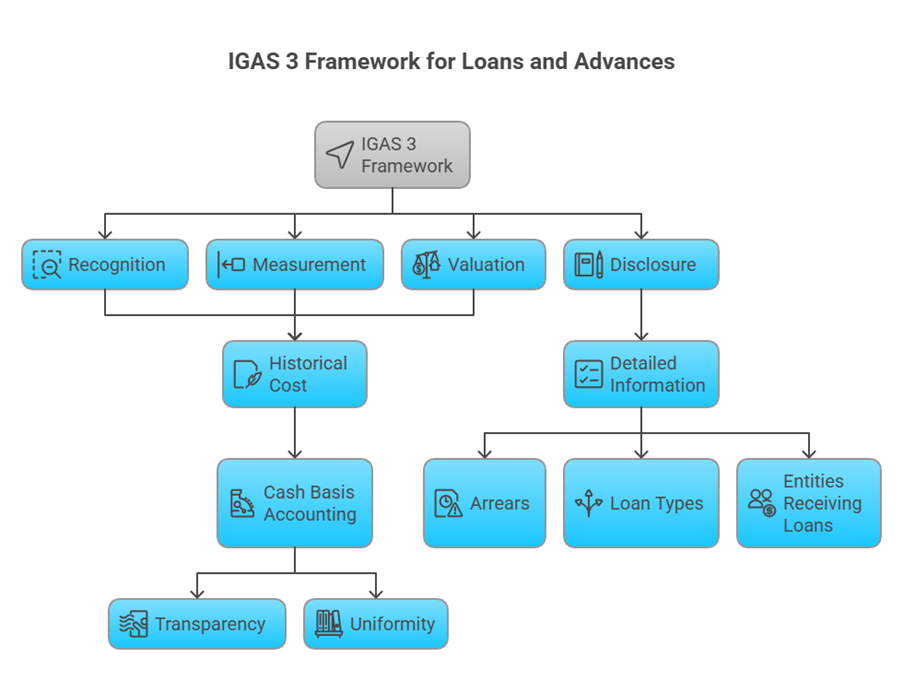
The Indian Government Accounting Standard (IGAS) 3, specifically concerning Loans and Advances made by Governments. This standard was issued by the Government of India, Ministry of Finance, following recommendations from the Comptroller & Auditor General of India. It was notified on February 13, 2012.
Authority and Background
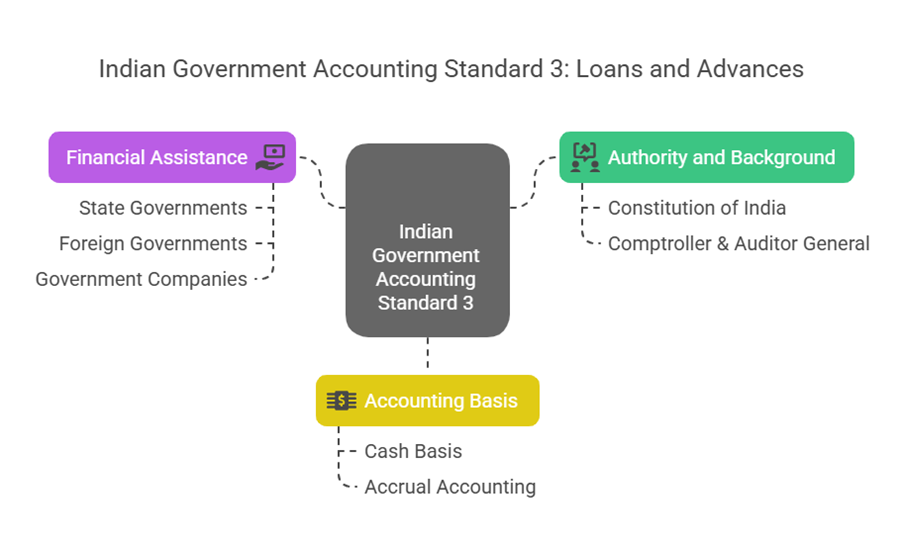
The Constitution of India Article 293(2) empowers the Government of India to make loans to States, subject to conditions laid down by or under any law made by Parliament, and allows sums required for this purpose to be charged to the Consolidated Fund of India. Article 150 mandates that the accounts of the Union and of the States shall be kept in such form as the Comptroller and Auditor General of India may, with the approval of the President, prescribe.
The Union Government has been providing financial assistance to State Governments, a substantial portion of which is in the form of loans and advances. Loans are also provided by the Union Government to Foreign Governments, Government companies and Corporations, Non-Government institutions, and Local bodies. State Governments also disburse loans to Government companies, Corporations, Local Bodies, Autonomous Bodies, Co-operative Institutions, Statutory Corporations, Quasi-public bodies, and other non-Government or private institutions. State Governments also disburse recoverable advances to Government servants. This wide range of entities receiving loans and advances necessitates a standardized accounting approach.
Historically, the accounts were maintained on a cash basis. The standard explicitly states that it shall only apply to government accounts maintained on a cash basis, until the prerequisite conditions for accrual accounting are met. This clarifies the context within which IGAS 3 operates.
Objective
The objective of IGAS 3 is to lay down the norms for Recognition, Measurement, Valuation and Reporting in respect of Loans and Advances made by the Union and the State Governments in their respective Financial Statements. This is aimed at ensuring complete, accurate, and uniform accounting practices, and to provide adequate disclosure on Loans and Advances consistent with best international practices.
Scope
IGAS 3 applies to Loans and Advances given by the Government for incorporation and presentation in the Financial Statements of the Government. As mentioned, it applies specifically to government accounts maintained on a cash basis.
Key Definitions
The standard provides definitions for several key terms used within its context. Understanding these definitions is crucial for interpreting the standard correctly:
- Accounting Authority: The authority responsible for preparing the Financial Statements of the Government.
- Accounting Period: The period covered by the Financial Statements.
- Advances: As per the standard, this term, where used in relation to loans and advances by the Government, is restricted to advances made to Government servants. This specific definition limits the scope of ‘Advances’ in the context of this standard to employee advances, distinct from loans given to external entities.
- Carrying Amount: The net amount which the debtor owes the creditor at any point of time. It reflects the historical cost of the loan and subsequent cash flows resulting in either a decrease due to repayments or write-offs, or an increase due to additional disbursements.
- Cash basis of accounting: This refers to the accounting transactions of an entity that represent the actual cash receipts and disbursements during a financial year, as distinguished from the amount due to or by the entity during the same period. The standard applies specifically to accounts maintained on this basis.
- ‘Charged’ and ‘Voted’ Loans and Advances: All loans and advances made by the Union Government are ‘charged’ loans and advances. For State Governments, loans and advances are ‘voted’ loans and advances. This classification relates to the method of appropriation from the Consolidated Fund.
- Consolidated Fund of India: The fund referred to in clause (1) of article 266 of the Constitution of India.
- Consolidated Fund of the State: The fund referred to in clause (1) of article 266 of the Constitution of India.
- Financial Statements: The annual Financial Statements of the respective Governments.
- Government: Refers to the Union Government or any State Government or Government of any Union Territory with a Legislature.
- Historical Cost: The original book value of loans and advances. Initial measurement and reporting are based on historical cost.
- Loanee Entity: An entity in whose favor a loan or an advance has been sanctioned by the Government.
- Loanee Group: Consists of a group of loanee entities of similar nature and characteristics.
- Loans: Assistance provided by the Governments by providing money, goods or services directly or indirectly to the beneficiary entities which entails a contractual right to receive back equivalent moneys along with interest thereon, if any, as per the terms and conditions of the loan agreements.
- Major Heads of account: Represent the functions of Government as per the ‘List of Major and Minor Heads of Account of Union and States’. They represent the list of major and minor heads of account of the Union government’s principal and minor heads. For State governments, they represent the list of major and minor heads of account of the State government’s principal and minor heads.
- Minor Heads of account: Represent various programmes or schemes undertaken by departments of Government to achieve the objectives of the function represented by the major head, as per the ‘List of Major and Minor Heads of Account of Union and States’. For Union governments, they represent the list of minor heads subordinate to the major heads. For State governments, they represent the list of minor heads subordinate to the major heads. They represent the list of minor heads subordinate to major and sub-major heads.
- Sub-Major Heads of account: Represent the sub-functions of Government and are under the Major Heads, as per the ‘List of Major and Minor Heads of Account of Union and States’. For Union governments, they represent the list of sub-major heads under main heads. For State governments, they represent the list of sub-major heads under main heads.
- Non-Plan Loans: Loans other than those sanctioned by the Government for plan purposes.
- Plan Loans: Loans sanctioned by the Government for plan purposes.
- Principal: that original amount which has been given by the lender to the debtor at a particular time. However, in the context of repayments, Principal refers to the part of the amount repaid, as distinguished from interest.
- Sector: Consists of a grouping of specific functions or services as per the ‘List of Major and Minor Heads of Account of Union and States’. They represent a grouping of specific functions or services according to the major and minor heads.
- Write-off: Occurs when a competent authority permits or writes off any loan owing to its irrecoverability or otherwise. Irrecoverable portion of a loan is transferred from the debt head of account to an expenditure head as loss to the Government. This applies to irrecoverable loans/advances.
- Loans in perpetuity: Refers to cases where only payment of interest is enjoined, or where interest payment alone is required.
Other definitions mentioned include:
- Arrear Amount: The amount due by a debtor at a particular time in lieu of principal, interest, or cash flow, which has been due and unpaid for a long time or has accumulated in the account due to discount/reduction and/or accrued interest.
- Data Lag: A loan or advances that a capable officer is unable to repay due to incapacity or for other reasons, and which is included in the ‘Data Lag’ head of account in the government’s financial statements as a loss to the government. (Note: The translation here seems slightly different from the common understanding of ‘Data Lag’. The context in the source suggests it refers to a classification of non-performing/irrecoverable loans/advances).
Recognition
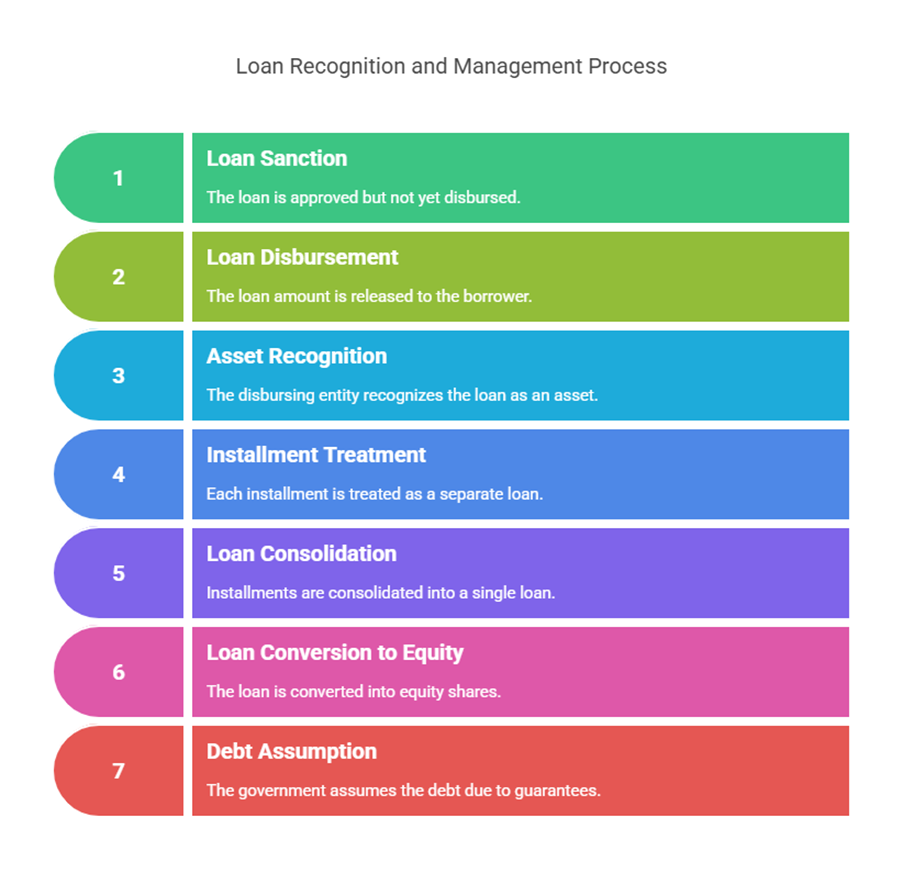
A loan shall be recognized by the disbursing entity as an asset from the date the money is actually disbursed and not from the date of sanction. This is a crucial point establishing the timing of asset recognition. If a loan is disbursed in installments, then each installment shall be treated as a separate loan for the purposes of repayment of principal and payment of interest, except where the competent authority specifically allows consolidation of the installments into a single loan at the end of the concerned financial year.
The standard also addresses specific situations:
- Loans converted into equity shall be treated as conversion and shall lead to a reduction in the outstanding loan amount.
- The debt assumption due to invocation of guarantees shall be treated as disbursement of loan, unless otherwise specified. This means when the government has guaranteed a debt and has to pay it off, this payment is recognized as a loan given by the government to the original debtor.
Measurement and Valuation
The standard specifies the method for measuring and valuing loans and advances. Historical Cost measurement is the basis for accounting and reporting on loans and advances made by Governments.
The carrying amount of loans shall undergo revision at the end of the accounting period. This revision accounts for additional disbursements made during the period and repayments or write-offs. As of the last date of the accounting period, the carrying amount is determined by the original value plus any additional disbursements, minus repayments and write-offs.
Disclosure Requirements
A significant portion of the standard is dedicated to comprehensive disclosure requirements in the Financial Statements of both the Union and State Governments. These disclosures aim to provide detailed information about the loans and advances portfolio.
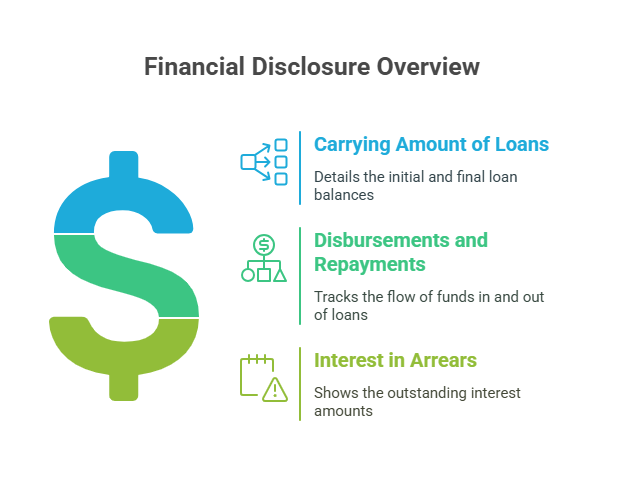
Financial Statements of the Union and State Governments shall disclose the Carrying Amount of loans and advances at the beginning and end of the accounting period. This disclosure should show additional disbursements and repayments or write-offs during the period to arrive at the closing balance.
An additional column in the relevant Financial Statements shall reflect the amount of interest in arrears. This amount is not to be added to the closing balance of the loan itself but is presented as additional information.
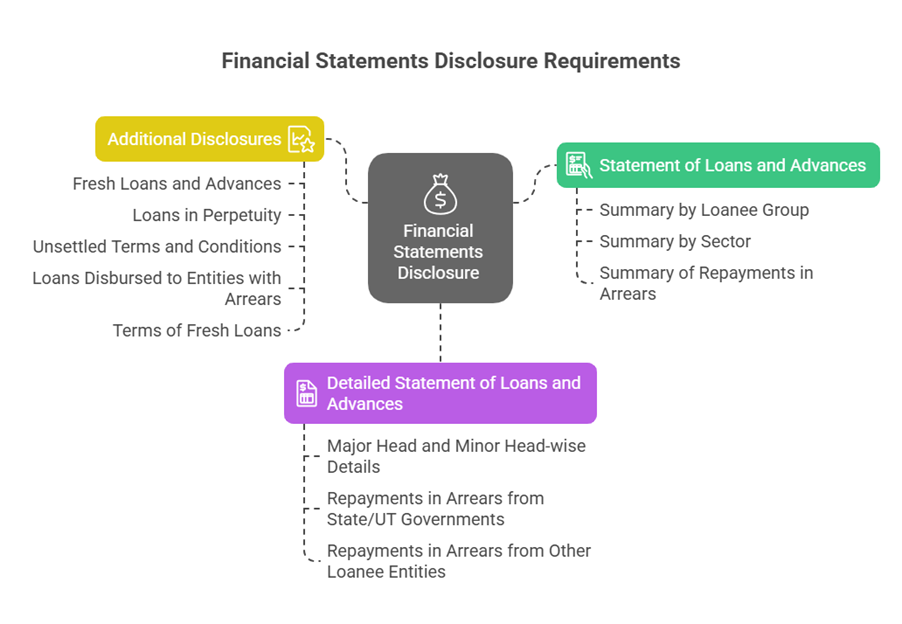
For the Union Government, the Financial Statements shall disclose the following details under ‘Loans and Advances made by the Union Government’ in the Annual Finance Accounts of the Union Government:
- Statement of Loans and Advances (often presented in three parts):
- Summary by Loanee group.
- Summary by Sector.
- Summary of repayments in arrears from State/Union Territory Governments and other Loanee Entities.
- Detailed Statement of Loans and Advances (often presented in three parts):
- Detailed statement of Loans and Advances showing Major Head and Minor Head-wise details.
- Detailed statement of repayments in arrears from State or Union Territory Governments.
- Detailed statement of repayments in arrears from other Loanee entities.
- Additional Disclosures (also presented in parts):
- Disclosure of fresh Loans and Advances made during the year.
- Information on cases of a loan having been sanctioned as ‘loan in perpetuity’.
- Information on loans for which the terms and conditions have not yet been settled.
- A statement on the quantum of loans disbursed during the year to those entities from which recoveries of earlier loans are in arrears.
- Disclosure of detailed information on the quantum and terms of fresh loans advanced during the year to loanee entities and recovery of earlier loans in arrears (including by way of payment of principal and interest).
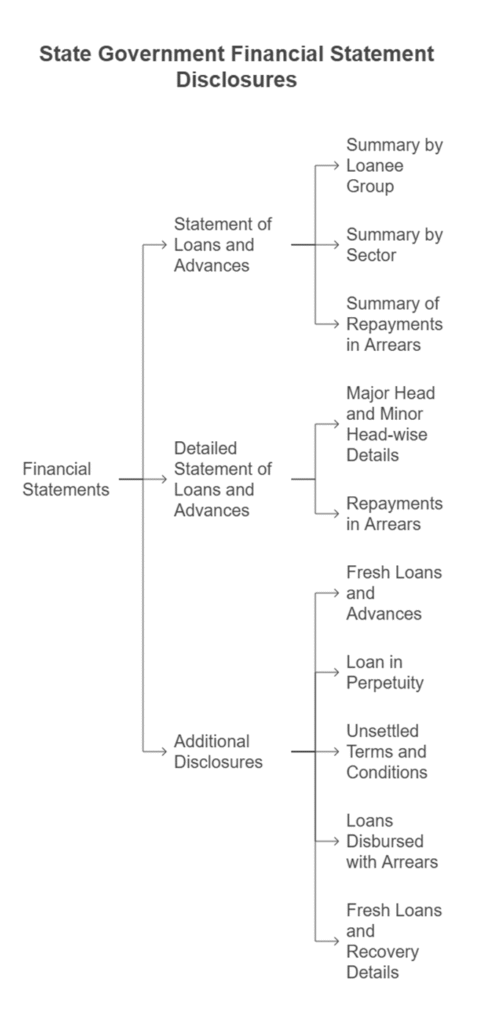
For the State Governments, the Financial Statements shall disclose the following details under ‘Statement of Loans and Advances made by the State Government or Union Territory Government’ in the Annual Finance Accounts of the State Government:
- Statement of Loans and Advances (often presented in three parts):
- Summary by Loanee group.
- Summary by Sector.
- Summary of repayments in arrears from Loanee entities.
- Detailed Statement of Loans and Advances (often presented in two parts):
- Detailed statement of Loans and Advances showing Major Head and Minor Head-wise details.
- Detailed statement of repayments in arrears from other Loanee entities.
- Additional Disclosures (also presented in parts):
- Disclosure of fresh Loans and Advances made during the year.
- Information on cases of a loan having been sanctioned as ‘loan in perpetuity’.
- Information on loans for which the terms and conditions have not yet been settled.
- A statement on the quantum of loans disbursed during the year to those entities from which recoveries of earlier loans are in arrears.
- Disclosure of detailed information on the quantum and terms of fresh loans advanced during the year to loanee entities and recovery of earlier loans in arrears (including by way of payment of principal and interest).
The information required for disclosure by the standard shall generally be provided by the Principal Accounts Offices of the Ministries and Departments.
The standard also specifies that repayment of principal and interest in arrears from loanee entities shall be disclosed. For Government entities, this disclosure should include the number of such loans and the total amount of loans outstanding against the entity, including those not in arrears, to indicate the entity’s creditworthiness. Both actual installments due and arrears of previous years may be disclosed with actual payment wherever feasible.
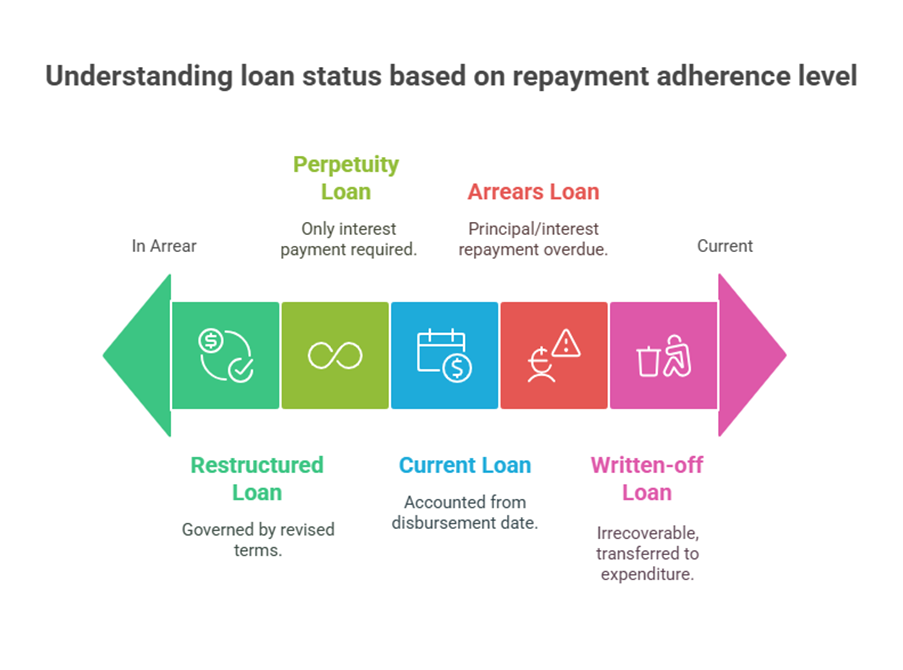
For cases of conversion or re-structuring or re-scheduling of loans, the re-structured loan should be treated as a current loan and not classified as being in arrear. The classification and such loans shall thereafter be governed by the revised terms and conditions and would be treated as in arrear if and when they subsequently fall in arrears with respect to interest payment and repayment of principal according to the revised terms.
Loans classified as “Data Lag” should be written off from the loan head to an expenditure head. Similarly, irrecoverable loans/advances are written off and transferred to an expenditure head.
It is stated that any loan sanctioned should be accounted for from the actual date of disbursement and not the date of sanction. If a loan is disbursed in installments, each installment is treated as a separate loan unless consolidated by competent authority.
Regarding loans in perpetuity, the sources indicate that they are loans where only payment of interest is required. The disclosure formats include specific sections for detailing such cases. The standard implies that such loans should not be classified as being in arrear if only interest payment is due and that payment is being made.
Effective Date
This Indian Government Accounting Standard becomes effective for the Financial Statements covering periods beginning the 1st April after the notification of the Standard by the Government. Since the standard was notified on February 13, 2012, it would become effective for the financial year beginning April 1, 2012.
Format for Disclosure
The standard includes formats for disclosures in the Financial Statements of the Union Government and the State Governments. These formats are provided in the sources and include various statements and additional disclosures. The formats are detailed, specifying columns for Loanee Group, Sector, opening balance, disbursements, repayments, write-offs, closing balance (carrying amount), net increase/decrease during the year, interest payment in arrears, Year of Sanction, Sanction Order No., Amount, Rate of Interest, Earliest period to which arrears relate, Total loans outstanding against the entity, Number of Loans, Total Amount of loans, Terms and conditions, Moratorium period (if any), and Reasons for disbursement during the current year. The disclosures are often presented in lakh rupees.
In summary, IGAS 3 provides a framework for the recognition, measurement, valuation, and extensive disclosure of Loans and Advances made by the Union and State Governments in India. It standardizes the accounting treatment based on historical cost and clarifies the reporting requirements, particularly focusing on providing detailed information about the loan portfolio, including arrears, different types of loans (plan vs. non-plan, perpetuity), and the entities receiving them. The standard applies specifically to accounts maintained on a cash basis and aims to enhance transparency and uniformity in government accounting for loans and advances.